
HOW THERAPY WORKS

Here's how I work with most of my clients. Stabilize first. Process the deeper material when you're ready. Integrate what we cover into how you actually live. It's a sequence, and each phase builds on the one before it. The Areas of Focus pages tell you how I apply this method to specific concerns. This page is about the method itself.
Call me directly. We'll start there.

CBT – How We Work on Thinking

What to Expect – The First Session

The Three-phase Method

headding

I work with two main modalities: Cognitive Behavioral Therapy (CBT) and EMDR (Eye Movement Desensitization and Reprocessing). They serve different purposes, and I tend to use them in sequence.
CBT is for the present. We work with the thoughts, triggers, and patterns that are running your day right now.

EMDR is for the root. We work with the older experiences that taught you those patterns in the first place.

In between, and around both, is integration. The practice you do between sessions is where the change becomes real. Symptoms first. Then roots. Then a new way of living that works better for you and the people you love.

Stabilize: CBT for the Present

When clients first come in, they’re usually overwhelmed. They can’t sleep. They can’t stop ruminating. They’re reacting in ways they don’t like, and they don’t know how to make it stop. That’s where we start. I use Cognitive Behavioral Therapy because it gives you immediate tools. The basic idea: your thoughts, your emotions, and your behaviors are connected. If you can interrupt one part of the sequence, you can interrupt the whole thing.
Here’s an example I use a lot. Imagine someone cuts you off on the freeway. Your first thought might be, “What an asshole.” That thought creates a feeling, usually anger. That feeling creates a behavior, like flipping them off or trying to cut them back off. The whole cycle takes about three seconds, and most of us go through it on autopilot.
CBT teaches you to slow that sequence down. You catch the thought, or you notice the feeling first if that’s what clues you in. Then you create some space. You might consider that the person who cut you off is rushing to the hospital. Maybe they have a sick kid. Maybe they’re just having a bad day. Now your feeling is different. Maybe a little compassion. Maybe just neutral. And the behavior shifts with it.
That's the work in the stabilize phase: noticing your patterns in real time and learning how to interrupt them. Most clients say they feel real relief within the first six sessions.

Process: EMDR for the Root

Once you have some tools and the volume turns down, we can look at where the volume was coming from in the first place. That’s where EMDR comes in. The basic premise: some experiences your brain processes in real time. You have them, you sit with them, you move on.
Others, especially the ones that involve overwhelm, fear, or shame, get stored in a way that doesn’t finish processing. The memory stays charged. When something in the present touches that charge, your nervous system reacts as if the past is happening again.
I write more about EMDR, including what a session looks like and how intensive EMDR works, on the Trauma Therapy & EMDR page. Not everyone does EMDR with me. Some clients never move into deeper trauma work. Some only come to me for EMDR and keep their primary therapist for everything else. We’ll talk about what makes sense for you on the first call.
EMDR helps your brain finish processing what got stuck. The memory is still there. It just stops driving your reactions.

Integrate: Practice Between Sessions

Change happens between sessions, not in them. What we cover in a session lands in the moment, but the part that sticks is what you do in your actual life between sessions. That’s where the change shows up: the argument you handle differently because you caught the trigger, the pattern you noticed in yourself a day before you would have noticed it last month, the conversation you didn’t have because you finally trusted your own instincts.

I’ll give you things to practice. Sometimes that means a specific exercise. Sometimes it just means paying attention to a particular pattern. I’ll ask you about it next session, and we’ll work with what you noticed.
Therapy with me is collaborative. I’ll provide the guidance, structure, and support, but lasting change also comes from what you practice between sessions. Our work together gives you the tools and insight to create meaningful changes in your everyday life.

HOW THERAPY WORKS

I think of the work as a triangle: mind, body, and soul.
What you eat, how you sleep, how much you move, and how you regulate your nervous system all affect what we can do together in session. I'll ask about those things because they're part of how you heal.
This isn't extra homework. It's part of the therapy.

What Therapy With Me Looks Like

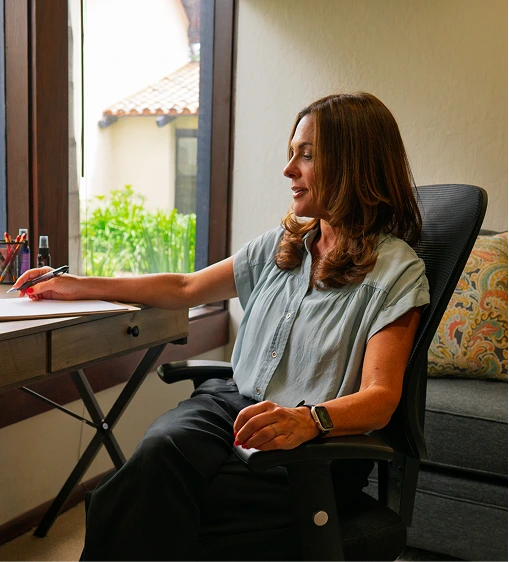
Clients describe my style as steady and grounding. I’m warm and nonjudgmental. I’m also active, direct, and engaged. I’ll challenge you when something needs to be challenged, and I’ll hold you accountable when that’s what the work needs. I’ll also tell you what I see in real time, including when I see you reaching for a pattern you’ve been trying to leave.
Listening is an important part of therapy, and I want you to feel heard and understood. At the same time, my goal is to help you move forward. I’ll be an active part of our work together, helping you make sense of what you’re experiencing and find ways to create meaningful change in your life.

How Long This Takes

Symptom relief usually shows up within the first six sessions. That’s the stabilize phase, and most clients feel real change by then.
The deeper work takes longer, and it varies by person. Some clients want to do focused EMDR over a few months and then stop. Others want to keep going for years, working through different layers as they surface.
There’s no right answer. We’ll talk about your timeline together, and I’ll be honest about what I see.

Frequently Asked Questions

Will you use other approaches besides CBT and EMDR?


Yes, when something else fits. CBT and EMDR are my primary modalities, but I draw on other approaches when the moment calls for it: mindfulness, person-centered therapy and family systems therapy. The modality is in service of the work, not the other way around.

What if I don't want to do EMDR?

That’s fine. Plenty of my clients do excellent work without it. EMDR is a useful tool when there’s unresolved material driving present reactions, but it’s not the only way to work with trauma, and it’s not the only path to feeling better.
Do I have to talk about my past?

Eventually, some of it will probably come up. But you set the pace, and I won’t push you somewhere you’re not ready to go. A lot of the work happens in the present.
How do you decide what we work on?

You bring the material, and I help you organize it. In the first few sessions I’m listening for patterns: what’s coming up for you, what your nervous system is doing, what core beliefs seem to be running underneath. From there we set goals together, and we adjust as we go.

Ready to Begin?

If this approach sounds like a fit, call me. We’ll start with one question: Tell me what’s going on. I’ll listen while you get it off your chest. If we’re a good match, we’ll begin.